
Saharan dust makes the air in Cape Verde hazy on about twenty days a year. It happens mostly from December to February. On Sal and Boa Vista it is then hazy or dusty on 4 to 5 days a month on average. From May to September it hardly happens at all.
A dusty spell usually lasts one or two days. Now and then it goes on for about a week. You will almost never see a real sandstorm here. What you see is a haze that hides the view.
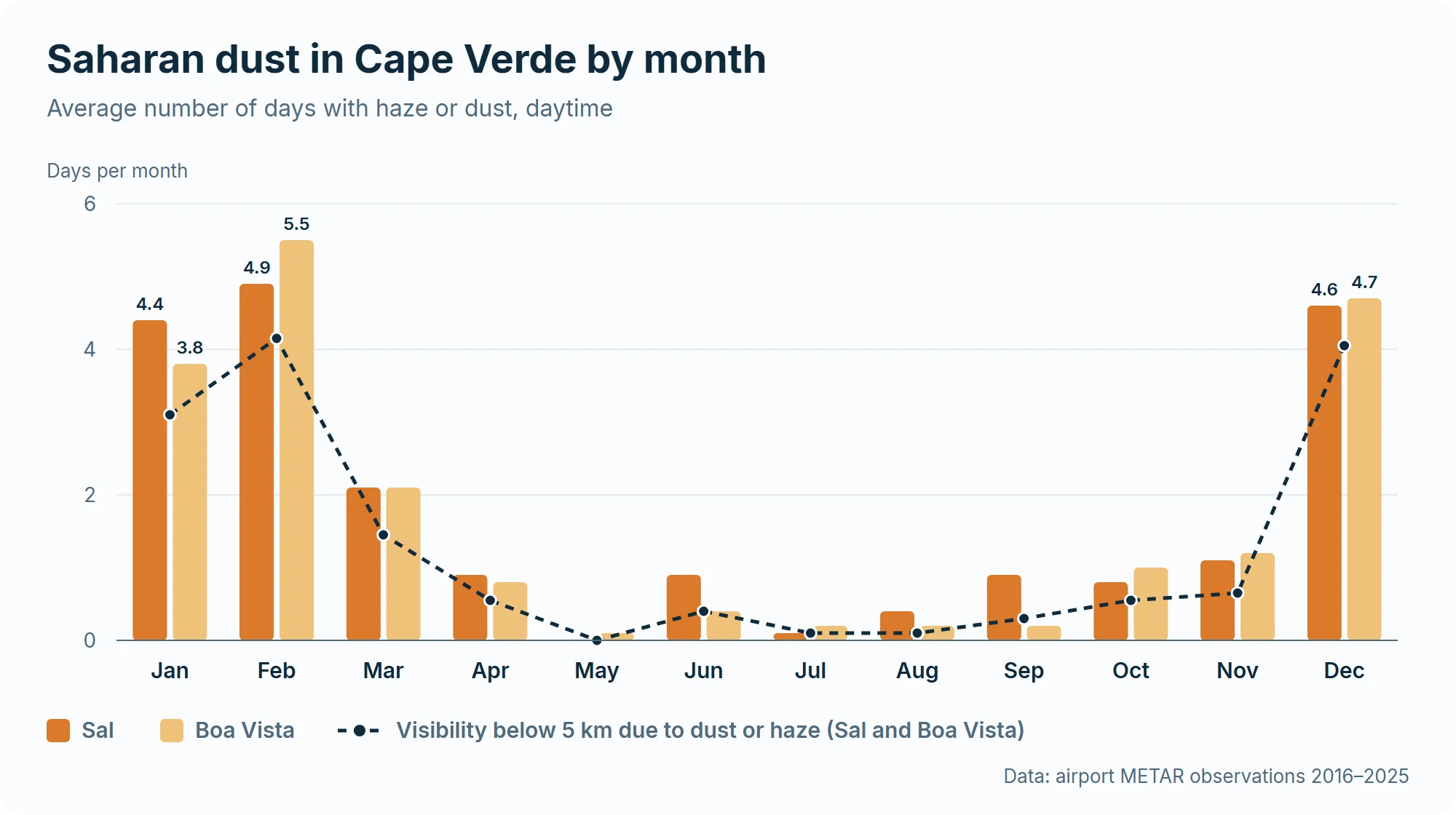
Saharan dust in Cape Verde by month
Is there Saharan dust right now? How to check
- The national weather institute of Cape Verde, INMG, issues warnings for bruma seca. Its website is inmg.gov.cv. Cape Verdean news sites such as Expresso das Ilhas also report them.
- NASA Worldview shows daily satellite images. Dust shows up as a beige or grey veil over the blue sea, as in the image below. If you see nothing yet, go back one day.
- Your airline knows first whether your flight is affected. Check its flight status shortly before you leave.
When is it hazy in Cape Verde?
The dust season runs from December to February. Two thirds of all hazy days fall in those three months. Add March and it is more than three quarters. November and March have the odd one; the rest of the year almost none.
Every year is different. In December 2017 Sal had fifteen hazy days. In December 2020, 2022 and 2025 it had none at all. January 2020 and February 2024 were also bad months on Sal, with ten to twelve hazy days.
In summer, dust from the Sahara also crosses the islands. It then travels high up, at up to 10 kilometres. On the ground you notice little of it and visibility stays good. In winter the dust comes in low, on the north-east wind. That is why it is hazy then.
Harmattan, bruma seca and lesta
The harmattan is a dry wind from the north-east or east over the western Sahara. It carries fine dust out over the ocean. Cape Verde lies about 570 kilometres off the coast of Senegal and gets that dust first. On the islands it is called harmatão, bruma seca (dry haze) or lesta. In Spain and the Canary Islands, Saharan dust in the air is known as calima.
Dust haze or sandstorm?
Most dusty days are dust haze. The dust was lifted somewhere else, sometimes far away in the Sahara, and now hangs in the air. In a sandstorm, a strong, turbulent wind lifts sand and dust on the spot. You hardly ever see that in Cape Verde.

Satellite image, 25 January 2024
In ten years, the weather observers at the four international airports reported haze or dust thousands of times, and a duststorm only seven times. When people talk about a sandstorm in Cape Verde, they nearly always mean thick dust haze.
What do you notice?
Visibility
On a normal day, visibility at the airports is 10 kilometres or more. On a dusty day it can drop below 5 kilometres. From December to February that happens on 3 to 4 days a month. Below 1 kilometre because of dust is rare: on average less than one day a year per airport.

Terra Boa, Sal
Sun
Haze and dust block part of the UV, but not all of it. You can still get sunburnt.
Breathing
Dust in the air is mainly a risk for the airways and for the heart and blood vessels. On dusty days, Cape Verde’s weather institute advises wearing a face mask when you go outside.
Flights
In thick dust a plane sometimes cannot land. It then diverts to another airport or stays on the ground. A few examples:
- Around Christmas 2016, Thomson could not land on Boa Vista for three days. Flights went to Sal.
- On 17 February 2021, TICV moved all domestic flights of that day, including those from Praia to Sal and São Vicente.
- On 25 and 26 January 2024 and from 18 to 20 December 2024, flights across the country were cancelled or diverted.
Dust this thick does not come every winter. Visibility below 1 kilometre occurs on less than one day a year on average.
Differences between the islands
Sal and Boa Vista get dust about equally often: around twenty days a year. Praia, on Santiago, has slightly fewer, around eighteen. São Vicente reports the fewest hazy days, but its figures since 2022 are hard to compare with earlier years.
The difference is small. A dust cloud usually covers all the islands at once; the bad days are almost the same at all four airports. What differs is how much dust a plane can handle at each airport. Sal has an instrument landing system and can still take landings at about 550 metres visibility. Praia needs 1,100 metres, São Vicente 2,400 metres. That is why flights often divert to Sal in dust.
Tips
- Use sunscreen on hazy days too. Haze blocks only part of the UV.
- If you want a view, for example from a viewpoint or on a boat trip along the coast, avoid a dusty day if you can. After one or two days it usually clears.
- Travelling in December, January or February with a connection or a domestic flight? Leave some slack in your plans.
Read more about the seasons on the climate in Cape Verde page and the weather per month. The trade wind and other winds are covered in wind in Cape Verde.
Frequently asked questions about Saharan dust
When is there Saharan dust in Cape Verde?
Mainly from December to February. On Sal and Boa Vista it is then hazy on 4 to 5 days a month on average. From May to September it hardly happens.
Are there sandstorms in Cape Verde?
Hardly ever. What people call a sandstorm is usually dust haze: fine dust from the Sahara hanging in the air. In ten years the four international airports reported a real duststorm only seven times.
How long does a dusty spell last?
Usually one or two days. Now and then it lasts about a week.
Can you get sunburnt when it is hazy?
Yes. Haze and dust block part of the UV, but not all of it. So use sunscreen as usual.
Can flights be cancelled because of Saharan dust?
Yes. In thick dust, flights sometimes divert or are cancelled. That does not happen every winter. Sal can still take landings in the poorest visibility, so flights often divert there.
Is Saharan dust bad for your health?
Dust in the air is mainly a risk for the airways and for the heart and blood vessels. Cape Verde’s weather institute advises a face mask outdoors on dusty days.
Data accounting
The graph counts, per month, the days on which the weather observers at the airports of Sal and Boa Vista reported haze or dust during the day, averaged over 2016 to 2025. The line counts the days on which visibility dropped below 5 kilometres because of dust or haze.